Nutrition / Guide
Nutrition guide
How your body uses energy from food
Your body does not digest calories directly. It digests nutrients, and protein, carbohydrate and fat each follow their own pathway before they become usable energy.
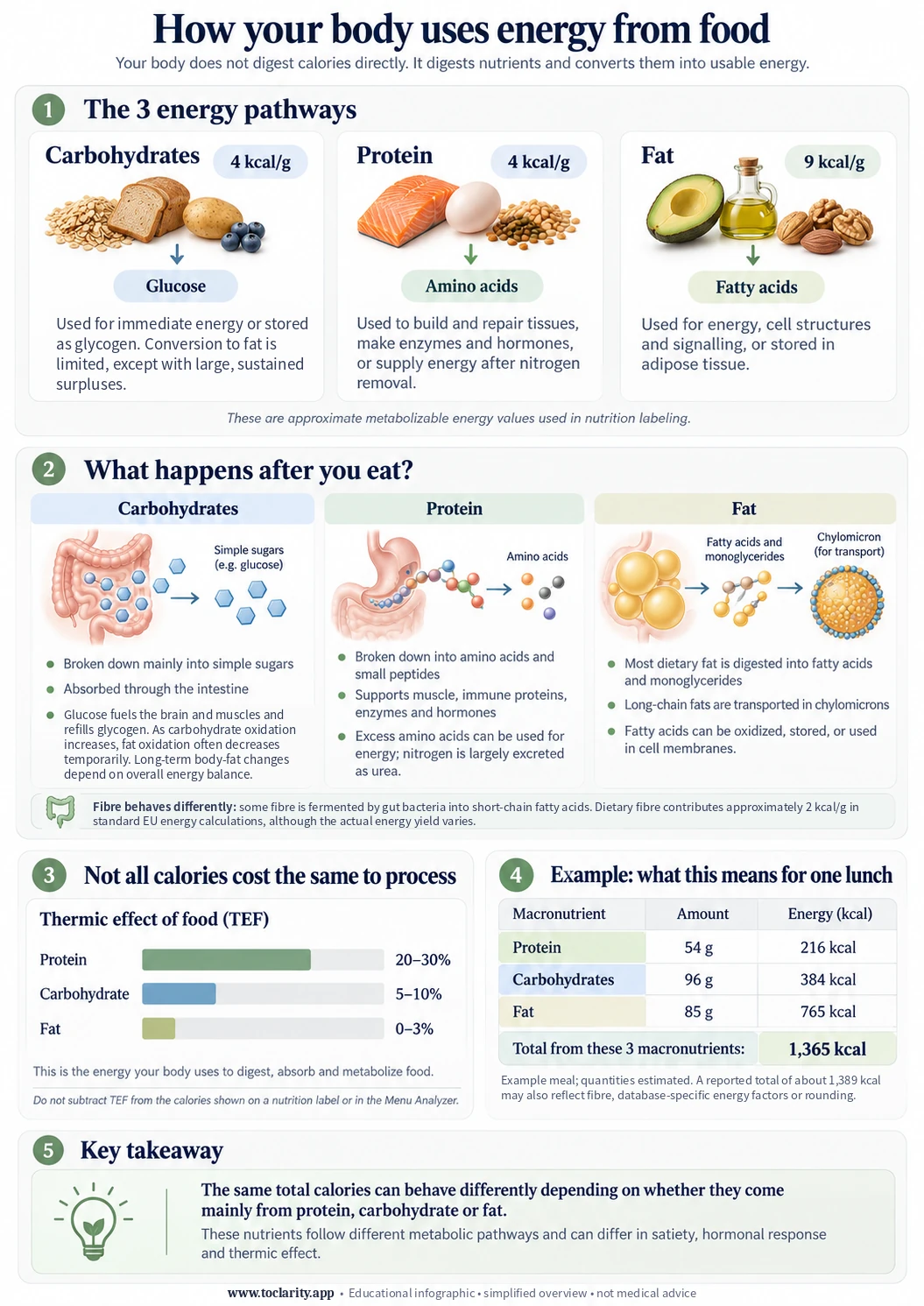
Infographic v1.4. Open full size
What the infographic simplifies
- Carbohydrate and fat are burned side by side
- When more carbohydrate is used for fuel, the body temporarily burns less fat. Turning carbohydrate into new fat is limited, except with large, sustained surpluses. Whether body fat changes over time depends on overall energy balance.
- Protein is not “repair first, energy later”
- Amino acids are used for building and repair and for energy at the same time, all the time. The body has no large store for them; when they are used for energy, the nitrogen is removed and excreted, mainly as urea.
- Fibre is not one thing
- Some fibre is fermented by gut bacteria into short-chain fatty acids. Dietary fibre contributes approximately 2 kcal/g in standard EU energy calculations, although the actual energy yield varies.
Not all calories cost the same to process
Digesting, absorbing and handling food uses energy too. Reported values are about 20 to 30% of the energy in protein, 5 to 10% for carbohydrate and 0 to 3% for fat. These are ranges, not fixed corrections: do not subtract them from the calories on a nutrition label or in My Nutrition, which already give the energy the body can use.
How this connects to My Nutrition
My Nutrition shows where a meal’s energy comes from using the same standard factors as EU food labels: 4 kcal per gram of protein or carbohydrate, 9 for fat and 2 for fibre. The split describes one meal; it is not a judgement. What matters more is the overall pattern across days, and the quality of the foods.
References
- Regulation (EU) No 1169/2011 on the provision of food information to consumers, Annex XIV: conversion factors for the calculation of energy. EUR-Lex
- Westerterp KR. Diet induced thermogenesis. Nutrition & Metabolism. 2004;1:5. doi:10.1186/1743-7075-1-5
- Acheson KJ, Schutz Y, Bessard T, Anantharaman K, Flatt JP, Jéquier E. Glycogen storage capacity and de novo lipogenesis during massive carbohydrate overfeeding in man. American Journal of Clinical Nutrition. 1988;48(2):240–247.
Educational overview, not medical advice. Last reviewed 18 October 2026.